Pattern
Palmistry (Hasta Samudrika)
The lens of pattern — lines, formations, and structural tendencies inscribed in the hand. Anchored in 10,000+ palm analyses.
Palmistry
What It Is
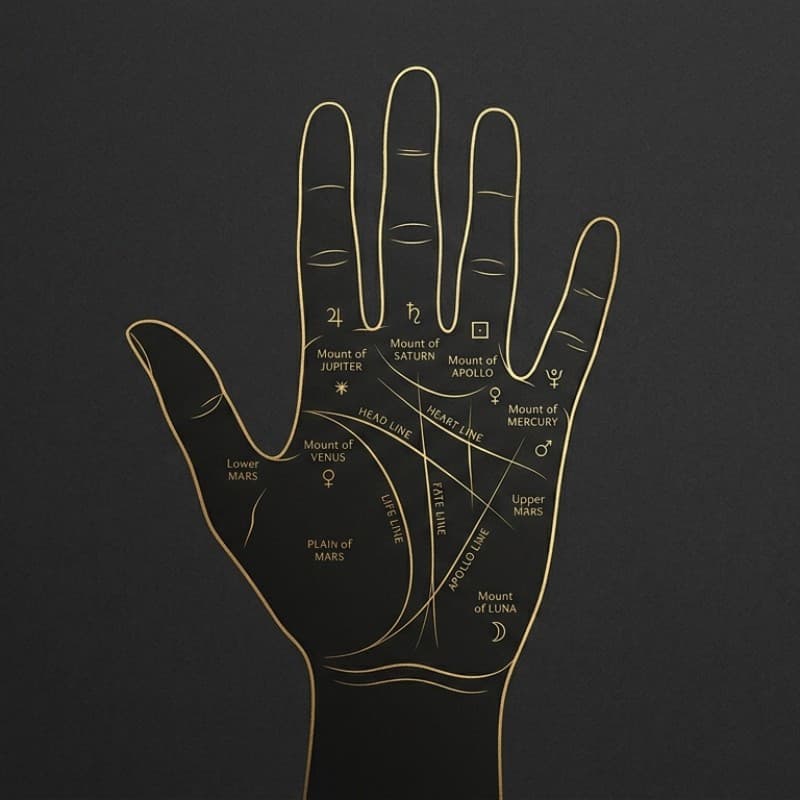
Palmistry is the pattern-lens of the framework, anchored in an experiential database of more than 10,000 palm analyses. Both hands are read — the dominant hand for active life patterns, the non-dominant hand for inherited tendencies — together with the front and back of the palm, the mounts, and the lines themselves. Palmistry serves a dual role in the Acharya Rathnam practice: as a primary source of insight, and as the validation tool that anchors astrological findings when birth data is uncertain or unavailable.
Who It's For
Individuals seeking clarity on life patterns and personal direction
Clients without verifiable birth time, where the chart needs to be reconstructed
Leaders cross-validating astrological guidance with a second physical reading
Families looking to understand a child’s tendencies before they fully emerge
The Process
Hand Examination
Detailed study of both hands — front and back, dominant and non-dominant — covering lines, mounts, finger proportions, skin texture, and fingerprint patterns.
Pattern Identification
Key life patterns, structural tendencies, strengths, and areas of attention are identified.
Cross-Reference
Findings are compared against the astrological chart and the face reading to build a fully integrated picture.
Discussion
Insights are shared with practical context and recommendations.
Periodic Re-Reading
Lines evolve over time. Periodic re-reading reveals shifts and confirms the impact of remedies undertaken.
Common Questions
Do palm lines really change over time?
Yes. The lines of the hand shift and evolve, reflecting changes in health, mindset, decisions, and circumstances. This is why periodic readings are valuable.
Why both hands, and why front and back?
The non-dominant hand reflects inherited tendencies; the dominant hand reflects what has been done with them. The back of the palm contributes structural and physiological signals that the front does not. Reading all four surfaces is what makes the pattern complete.
Can palmistry replace the horoscope?
When birth details are unavailable or unreliable, palmistry can substantially substitute for the horoscope and is used to reconstruct one. When both are available, they are read together — neither replaces the other.